• H O M E • C
O M I C S • L I N K S
• B L
O G
• C O N T A C T
•
• P E D A G O G Y •
GRAPHIC NOVELS
For
the College Classroom
GRAMMAR
For
the College Classroom
• S
C R I B B L I N G S •
PRIMITIVE ARCHER MAGAZINE
Hunting
Through
Medieval Literature
INTERDISCIPLINARY
HUMANITIES
Classroom
Comics: Children's
Medium and the New Literacy
GODDESSES
IN WORLD CULTURE
The
Maiden with a Thousand
Slippers
INTERDISCIPLINARY
HUMANITIES
Peter
Pan
HORSE
& RIDER MAGAZINE
A Whisper and a Prayer

COURSE CURRICULUM
ARTICLE
Christine de Pizan
CONFERENCE
PAPER
Hostages
in the Rose Garden
Links to CLASSIC TEXTS
A
note about study guides: Glenco (McGraw Hill), SparkNotes, and Shmoop
tend to be the best for students as they provide some basic background
on the author and his or her times as well as a myriad of activities that
involve critical thinking, not just regurgitating plot. The Great Books
Foundation guides are also good. Note: Schmoop does a good job, but you
have to wade through the saracasm.
For teacher's guide, the Penguin and Random
House versions offer discussion guides and suggested activities.
1984
by George Orwell. A prescient sci-fi story of surveillance and totalitarianism.
>Great
Books Foundation Student Guide
>Penguin
Teacher's Guide
Alice's
Adventures in Wonderland by Lewis Carroll while written as
a children's book has something for everyone and is now seen as an exercise
in experimental writing.
>Random
House discussion guide.
Animal
Farm by George Orwell. A story of oppression and corruption
in the barnyard. "All animals are created equal, but some are more
equal than others."
>McGraw
Hill student reading/discussion guide.
>Penguin Teacher's Guide
Babbitt
by Sinclair Lewis is the story of a real estate developer with political
aspirations. The work satirizes the American middle class.
>Spark
notes study guide
Benito
Cereno by Herman Melville. The first pirate story ever written.
It takes place on board a slave ship and the ending is delivered with
a twist (Part of The Piazza Tales).
>Schmoop
student guide.
The
Big Sleep by Raymond Chandler is a noir classic starring the
hard-boiled detective Philip Marlowe.
>Student
discussion questions
Brave
New World by Aldous Huxley looks at a society that accepts
subjugation at the hands of technocrats.
>Great
Books Foundation student guide.
Candide
by Voltaire is a satire of philosophic optimism experienced by a young
man who encounters many misfortunes.
>Penguin
study guide
Count
of Monte Cristo
by Alexander Dumas. When revenge tragedies went
out of fashion, Dumas wrote a revenge novel.
>Shmoop
student guide.
Do
Androids Dream of Electric Sheep? by Philip K. Dick A classic
sci-fi that examines the question about what it means to be human in a
dystopian noir world.
>Schmoop
student guide.
Don
Quixote de la Mancha by Miguel de Cervantes is a satiric
peek into the chivalric world of Spain through the eyes of an old knight
>Teacher's
guide
>SparkNotes
for students
Dracula
by Bram Stoker. Every vampire tale ever told begins with this classic.
Interesting twist: discuss the new technology in the 18th century.
>Lit
Lovers student reading guide.
The
Daughter of Time by Josephine Tey. A modern police officer
investigates the alleged crimes of Richard III. Top 100 Mystery novels
of all time and a great, quick read.
>Discussion
Questions

The
Foundation Series by Isaac Asimov. Winner of
many Hugo Awards. It tries to do for science fiction what Gibbons'
epic, The Rise and Fall of the Roman Empire, did for history.
>Penguin
Reading Guide (mixed with other stories)
>Shmoop
Guide
Frankenstein
by Mary Shelley. Written on a bet, this is the original Halloween story.
The novel discusses morality in the time of technology (when technology
was in its infancy).
>Glencoe
student study guide.
>Penguin teacher's guide.
Great
Expectations by Charles Dickens. This is a Dickens mega-novel
complete with orphans, reversals of fortune, and one really creepy spinster.
>Glencoe
student guide.
>Penguin
teacher's guide.
The
House of Mirth by Edith Wharton. The gilded age puts women
in gilded cages from which many never escape and if they do they will
curse their sudden and inevitable betrayal.
>SparkNotes
reading guide
I,
Claudius by Robert Graves is written as an autobiography displaying
a decadent and brutal Rome. One of Time Magazines 100 All-Time
novels.
>Discussion
questions.
The
Invisible Man by Ralph Ellison displays what it was like to
be African American in the 1950s.
>Random
House Teacher's Guide
>Random House Reader's Guide
Hiroshima
by John Hersey looks at the dropping of the atomic
bomb from the POV of six survivors.
>Shmoop
reader's guide.
The
Hobbit by J.R.R. Tolkien. Fantasy in a fast-paced adventure
story that started it all.
>Spark
notes student discussion guide
>Random
House Teacher's Guide
Jane
Eyre by Charlote Brontë is the tale of a woman who marries
her boss told as a gothic romance with a character that is surprisingly
independent.
>Glencoe
student guide.
>Penguin
teacher's guide.
The
Last of the Mohicans: A Narrative of 1757
by James Fenimore Cooper is a novel set during the French and Indian War
in the wilderness of New York focusing on the last members of a Native
American Tribe
>Student
Discussion Guide
>Penguin
Reader's Fact Sheet
The
Lone Ranger and Tonto Fistfight in Heaven by Sherman Alexie
The book's central characters, Victor Joseph and Thomas Builds-the-Fire,
are two young Native-American men living on the Spokane Indian Reservation.
>Discussion
Questions
Lost
Horizon by James Hilton is a fantasy
about the fictional utopia, Shagra-La, whose inhabits appear to live forever.
>Harper
Collins' discussion guide.
The
Loved One by Evelyn Waugh. Dark humor at a Hollywood funeral
home. Great movie with lots of stars (if you can find it).
>Analysis
and discussion questions
The
Maltese Falcon by
Dasheill Hammett is the classic noir mystery.
>CSUN
study guide
>Shmoop
study guide
Maus:
My Father Bleeds History
by Art Spiegelman is a graphic depiction of the horrors of the Holocaust
that won a Pulitzer Prize for non-fiction.
>Random
House Study Guide
Metamorphosis
by Franz Kafka. One morning a salesman wakes up to find himself transformed...
>Glencoe
student reading guide
Mrs.
Dalloway by Virginia Woolf explores a day in the life of a
post WWI high-society British woman.
>Spark
Notes study guide
>Teacher's
Notes British Library
The
Mysterious Stranger by Mark Twain. Main character, Satan,
nephew of the one by the same name, looks at the meaning of life and other
issues, like religion and God.
>Study
guide by the Mark Twain House
Neuromancer
by
William Gibson. The original cyber-punk cowboy jacks into cyperspace.
>Shmoop
study guide
The
Once and Future King by T.H. White is based on L'Morte
d'Arthur and is a humorous, often anachronistic, work mocking power
and (in)justice.
>Shmoop
study guide
One
Day in the Life of Ivan Denisovich by Aleksandr Solzhenitsyn
follows a simple carpenter during a typically unpleasant day at a Soviet
labor camp.
>Glencoe
student guide.
>Penguin
teacher's guide.
The
Picture of Dorian Gray by Oscar Wilde tells the tale of a
man, his portrait, and a deal with the devil.
>Spark
Notes student guide.
>Penguin
teacher's guide.
Pride
and Prejudice by Jane Austen. Often
cited as Austen's best work, this movie, errr, I mean book is the original
rom-com.
>Glencoe
student discussion guide
>Penguin
teacher's guide.
The
Scarlet Pimpernel by Baroness Orczy
tells the tale of a British spy trying to save French royals from certain
death during the French Revolution.
>Penguin
Teacher's Guide
>Random
House student guide
The
Strange Case of Dr. Jekyll and Mr. Hyde by Robert Louis Stevenson
can be seen as the ultimate tale of addiction that displays man's ability
to be both evil and good.
>Glencoe
Student Guide.
>Penguin
Teacher's Guide.
The
Stranger by Albert Camus is about a
man drawn into a senseless murder byexploring the nature of the absurd.
>Shmoop
discussion guide
Their
Eyes were Watching God by Zora Neale Hurston presents a female
coming-of-age story and is a seminal African American work.
>Student
reading guide.
This
Side of Paradise by F. Scott Fitzgerald tells the story of
a disillusioned Princeton grad who learns that life outside the ivy walls
is nothing like what he expected.
>Student's
reading guide.
Tragedy
of Pudd'in Head Wilson by Mark Twain is a pre-Civil War critique
of society's obsession with race while examining nature vs. nurture. It
involves a court case that is the first to use forensics to solve a crime.
>Student
reading guide.
The
Turn of the Screw by Henry James a gothic ghost story focused
on a governess caring for two children on a remote island.
>Shmoop
guide
Twenty
Thousand Leagues Under the Sea by Jules Verne is one of the
first hard sci-fi novels of its day giving us a look at submarine travel
in 1868.
>Schmoop
student guide.
The
Underdogs: A Novel of the Mexican Revolution by
Mariano Azuela tells the story of some civilians dragged into the Mexican
Revolution.
>Random
House discussion guide
Vanity
Fair by William Makepeace Thackery. The story of Becky Sharp,
the original social climber.
>Penguin/Random
discussion guide
>Shmoop
discussion guide
War
of the Worlds
by H.G. Wells offers a look at what an alien invasion might look like
and has spawned numerous movies and one famous radio play. This work has
never been out of print. Wells, like Jules Verne, predicted many advances
in technology.
>WSU
student's guide.
Watchmen
by Alan Moore and Dave Gibbons is one of the most commonly found graphic
novels in the classroom and one of the things that attracts teachers and
academics is its complicated literary format. Named one of Time Magazines
Top 100 Novels of the Twentieth Century.
>CBLDF
Discussion Guide
Lots of Shmoop videos which can be silly, but they quickly get the point across.
Both Sides of the Story by Shmoop (CC).
Can my Essay be in First Person? by Shmoop (CC).
Dare
to Disagree
Most people instinctively avoid conflict, but as Margaret Heffernan shows
us, good disagreement is central to progress (Subtitles).
How to avoid repetition in an essay by Shmoop (CC).
How
to Get your Ideas to Spread
Marketing guru Seth Godin spells out why, when it
comes to getting our attention, bad or bizarre ideas are more successful
than boring ones (Subtitles).
How to identify ethos, logos, and pathos by Shmoop (CC).
How to write an Argument Essay by Shmoop. Their CC videos can be goofy, but they get the idea across.
How to write an introduction to a literary analysis.
How to write a literary reserach paper by Ways and How
How to write a killer thesis Statement by Shmoop (CC).
How to write a summary by Shaun (all of Smrt English videos are excellent).
Literary Analysis Paragraph Structure.
Outlining by Shmo0p (CC).
Phrases, Clauses, and Sentences by Shmoop (CC).
Plagiarism by Shmoop (CC).
Run-on Sentences by Shmoop (CC).
Sentence Fragments by Shmoop (CC).
Subject/verb agreement by Shmoop (CC).
Synthesizing Information by GCFLearnFree.org (CC).
The
Impact of Persuasion
Don Norman is the leader in the application of human-centered design.
“All design,” says Norman, “whether of a product, a company, a service
or an experience is ultimately aimed at satisfying human and societal
needs.”
Thesis statement vs topic sentence by Shmoop (CC).
THUNK 106: The Toulmin Method of Argumentation by THUNK (CC).
Top 10 Essay Writing Don'ts by Shmoop (CC).
Transitions by Shmoop (CC).
Using Citations Effectively by Shmoop (CC).
What not to do in an introduction by Shmoop (CC).
What not to do in a conclusion by Shmoop (CC).
Writing a Killer Conclusion by Shmoop (CC).
Links for ETHOS, PATHOS, and LOGOS
How to write a rhetorical analysis video: Writing Center: Rhetorical Analysis
After reviewing ethos, pathos, and logos, a good way for students to understand these rhetorical concepts is by analyzing television commercials.
As I tell my students, the greatest practioners of rhetoric are advertisers. Their whole job is to convince you to part with your money. One of the best shows in recent television history is Mad Men and they present some really good lessons in ethos, pathos, logos.
According
to Aristotle, the best speakers (or writers) utilize all three appeals
when it comes to arguments, but if you really want to move people
to action (such as opening their wallets), you must resort to pathos
(the basest form of argumentation) -- think about those horrible "Save
the abused animal" commercial.
>Ethos, Pathos, Logos powerpoint.
The
Art of Rhetoric: Persuasive Techniques in Advertising
Ethos, pathos,
and logos in advertising.
Logorama and academy award winning short using nothing but company logos. What does this say about consumerism?
Budweiser
Budweiser Superbowl 2015 Commercial with a rhetorical analysis of Budweiser's "lost puppy" commercial. We discuss the use of rhetorical strategies and appeals to ethos, pathos, and logos in a close reading of the film.
Old Spice
Let's
start off with a presentation of ethos, pathos, and logos
in "The Man Your Man Could Smell Like"
Rhetorical Analysis
of The Man Your Man Could Smell Like
Now it's your turn. How does Old Spice use ethos, pathos, and logos in the next commercial?
Should your Man Smell Like an Old Spice Man?
Logical Fallacies
Before moving on let's take a look at how logical fallacies are used in advertising, politics, and popular at the Logical Fallacies project, including slippery slope, red herring, non sequitur, post hoc, bandwagon, ad hominem, false authority, hasty generalization.
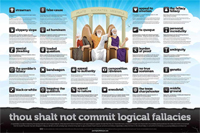 Your
logical fallacy is . . . is a website that offers a great handout
and some interactive examples. This shows that there are quite a few different
kinds of fallacies.
Your
logical fallacy is . . . is a website that offers a great handout
and some interactive examples. This shows that there are quite a few different
kinds of fallacies.
How
to Think, Not what to Think is a TedTalk by the creator of the
logical fallacies website, Jesse Richardson, and make some good points
about rhetoric.
This prezi project on Logical Fallacies within Advertising points out some fallacies in the Old Spice commercial above.
Here's
some famous fallacies:
Slippery slope on Direct
TV
Post hoc fallacy from Bud
Light
Five
Fallacies | Idea Channel
Straw
man fallacy, ad hominem attack, black and white fallacy (either/or), authority
fallacy, no true scotsman (universal)
Even
More Fallacies | Idea Channel
Don't forget counterarguments! Fallacy fallacy (if there is a fallacy
idea/argument must be bad), sharp shooter fallacy (cause/effect reversed),
moving the goalposts (raising the bar)
An Illustrated Book of Bad Arguments combines two of my favorite things - comics and rhetoric. A fun look at fallacies that tries to make understanding them a bit easier.
Mad Men
Let's look at the Mad Men expert, Don Draper, and how he explains his use of ethos, pathos, and logos in advertising.
Pitches based on nostalgia: Kodak Carousel and Hershey's Chocolate.
Pitches based on sex appeal: Jaguar, Gillette, and Lipstick, Jantzen Swimsuits.
But
why choose one cigarette, toothpaste, or cereal over another? Cigarettes
are what is known as a parity product--a product that is functionally
equivalent to its competitiors.
At Mad Men they
have given up on ethos (positive medical testimony) and are going
to stick with logos when pitching Lucky
Strikes.
Q) All successful ads combine all three elements of argument--ethos, pathos and logos--to sell products. Can you identify how each ad uses these three elements of appeal?
Q) What logical fallacies can you spot?
McDonalds
Teaching rhetoric with McDonalds. Here's a look at ethos:
"The Showdown" - Bird vs. Jordan McDonald's ad - 1993
and a modern remake
McDonald's Commercial with LeBron James and Dwight Howard
Q) How does McDonald's use ethos in these commercials? (Wanna be an athlete like Larry Bird, Michael Jordan, Dwight Howard, or LeBron James - eat McDonald's)
Q) Why did McDonald's create the same commercial with different athletes? (Appeal to younger generation audience)
Teaching pathos:
You don't even need to understand the words to get what's going on in this commercial:
McDonalds Shrek 3 Commercial in Spanish
Q) How does McDonald's use pathos in this commercial? (Appeals to the baser emotion of greed - children want all the cups)
Teaching logos:
McDonald's Happy Meal Ad Cha Cha Slide
Q) How does McDonald's use logos in this commercial? (McDonald's has healthy food - apples. It's convenient.)
More ethos:
Two Japanese McGrand commercials. The first was created via a Project Runway segment:
The second is designed for young men?
Q) How does McDonald's use ethos in these commercials? (Wanna be a skinny model? Eat McDonald's).
And now for something completely different, especially if you are coulrophobic. The Happy Meal
READ,
THINK, WRITE
It's
what I tell my students, and it's what every writer should practice.
READ anything including magazines, newspapers, comic books, graphic novels, fiction and non-fiction full-length books--it's one of the few things the internet is good for.
READ every genre, including sci-fi, fantasy, mystery, poetry, thriller, essay anthologies, historical fiction, short story collections, literary fiction and non-fiction and every medium AND that includes comics.
SUGGESTED
READING FOR A LIFETIME: Dr. Eliotelf
Dr. Eliot was a Harvard University President who gathered a 51-volume
anthology together of the "classics" to provide students an excellent
liberal studies education. A list of Dr. Eliot's Classic titles can be
found at Wikipedia under "Harvard
Classics".
For More READING Lists and Links to History and Favorite authors click on >Links
For Comic READING sites and lists click on >Graphic Novels for the College Classroom
WRITING For the College Classroom
Read-Think-b4-u-write. blogspot.com has lots of writing prompts, grammar tips and exercises. It also contains posts about rhetoric, careers, advertising, comics, and reading.
A Curious Question offers hundreds of prompts to jumpstart your journaling. Remember, practice makes perfect and that includes writing, the more you write the better you'll get.
GRAMMAR -
The Impotence of Proofreading - hysterical.
The problem with English grammar is that most rules have exceptions. In this electronic age, grammar standards are changing to keep pace with changing technology. The more I read, the more I see author's breaking language rules, changes which may now be conventions. What's a writer to do? Avoid some of the most common grammar errors (see a few tips below).
I hesitate devoting large segments of class time to grammar because it often leads to that "deer in the headlights" look that means my students have just gone into the "fear or flight" mode. College students should be familiar with the basics, and often are, however they don't know what your talking about when you use phrases like "faulty parallelism," "dangling modifier," or "verb agreement." One suggestion I give students is to buy a good, cheap "Handbook for Writers." They include basic grammar and can be found in any used bookstore (if there is one in your town). Then as a teacher you need to show them how to use the index.
For students who want to write beyond the basics, I recommend William Strunk Jr. and E.B. White's Elements of Style, it is well worth studying. It's super short—the copy I have is only 85 pages—and worth the read.
Here's a few basic grammar tips for the things I see most often:
•
Avoid overuse of the verb "to be" (is, was, were, are, been,
being)
My favorite professor's pet peeve.
• Avoid starting sentences with "It," "There is," or "There was." When you do it sounds like amateur hour, especially when you use them over and over, then it just gets annoying.
• Limit common dialect and contractions to dialogue, and then use sparingly.
• Do NOT use text messaging language in papers. While this form of verbal short hand is good for taking notes, it is not appropriate in any college level paper or manuscript (Yes, I actually do have to say this to students).
• Avoid the overuse of "I". Many students have been taught by their high school teachers to avoid I completely because it leads to too much personal opinion. In college, on the other hand, professors strive towards informed personal opinions. The problem lies in finding ten "I"s on a single page, or a paper where every other sentence starts with "I did this" or "I believe that." Again, repetition just gets annoying.
• And the first of my personal favorites (meaning, "the hardest error for me to break"): avoid Yoda speak, i.e. the pointy-eared little monk from Star Wars. "Tax returns they have been filed," should be "Filed tax returns." "The newspaper was taken by the dog," should be, "The dog took the newspaper." "Plans to marry," should be, "Marriage plans."
• Favorite bad habit number two (yes, that's mine): Contrary to purple pens, adjectives and adverbs often do not strengthen verbs, they weaken them.
held tightly = gripped, clutched
froze over completely = froze
wrapped tightly = bundled
pull energetically = jerk
moved slowly = sauntered
sat heavily = plopped
desperately wanted = desired
• Which leads to favorite bad habit no. 3: When the crew of the USS Enterprise decided to "Boldy go where no man has gone before" they split their infinitives. They should have decided “To go boldly where no man has gone before." A split infinitive occurs when an adverb or adverbial phrase is placed between to and the verb.
School House ROCK
I use "School House Rock" as a refresher and then ask students to define the grammar term and provide an example in a complete sentence. These short videos are memorable and fun, but BEWARE, you'll be singing "Conjunction Junction, what's your function" for the rest of the day.
Mr.
Morton - Subjects and Predicates
Rufus Xavier Sarsasparilla (Pronoun)
Lolly, Lolly, Lolly Get Your Adverbs Here
Online Grammar RESOURCES
Cengage Learning - These grammar quizzes can be emailed to the instructor and cover everything from subjects and verbs in simple sentences to capitalization and punctuation. Quizzes take anywhere from three to five minutes to complete and there are about 100 to choose from. I often use as an extra credit possibility.
Identifying Sentence Errors - SAT Practice Test - Sentences ask students to identify specific errors. There is also a "show me the answer" option with an explanation of the error.
Grammar
COMICS
How and why to use Whom in a sentence - he=who, him=whom
How to use an apostrophe - "The soldiers' rifles were no match for Bob's amazing lightning pants."
How to use a semicolon - the most feared punctuation on earth.
How to use "literally" - without exaggeration.
Ten Words you need to stop misspelling - "alot is not a word, you don't write alittle or abunch..."
When to use i.e. in a sentence - "The best way to take out a unicorn is with a claymore, i.e. a directional mine which explodes shrapnel into a designated kill zone."
Online Writing LABS
Owl at Purdue - A great site for basic grammar and citation questions. From practice questions to tips for avoiding plagiarism and writing a résumé, there is something here for every college student.
Hypergrammar - University of Ottawa Writing Centre - Lots of basic grammar pages with lots of good examples, but they use British spellings . . . like centre rather than center, so beware.
